
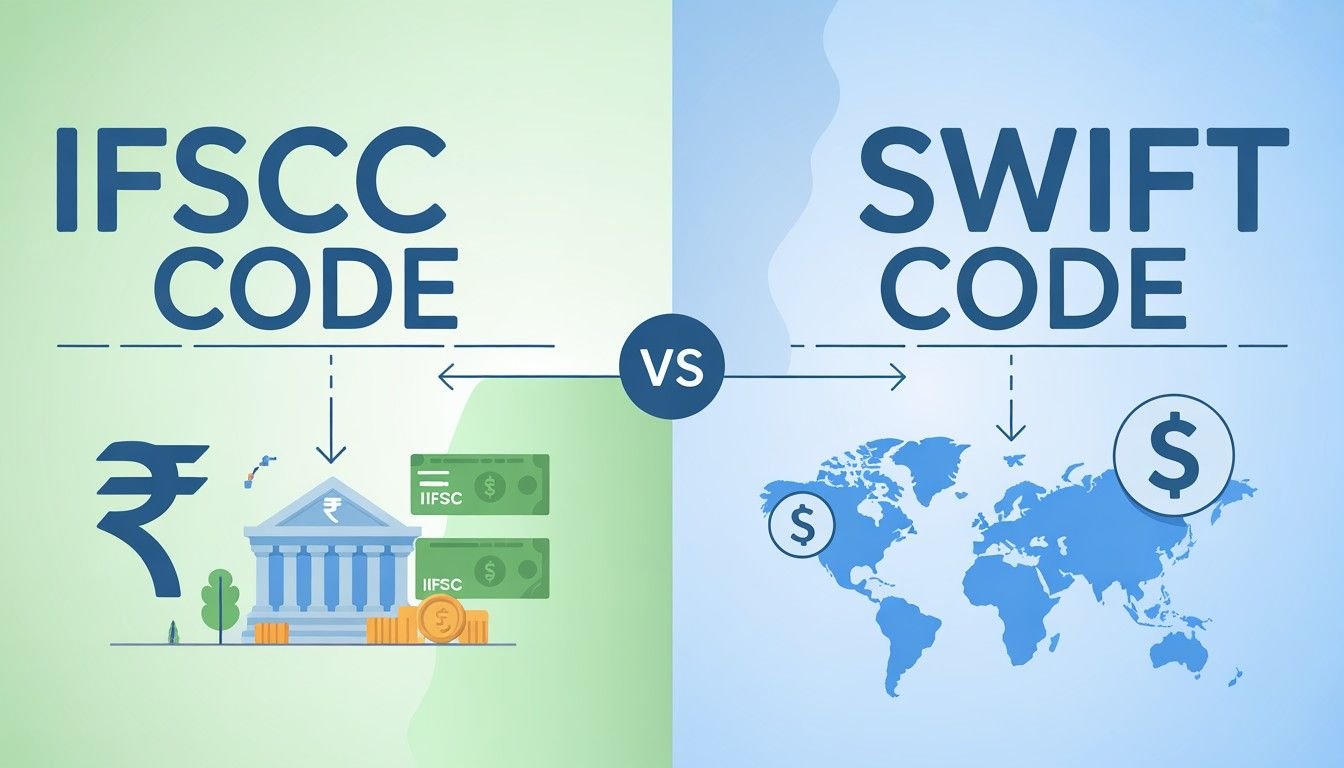
💰 IFSC Code vs SWIFT Code – What’s the Difference?
In today’s digital banking world, sending money has become faster and more accessible than ever. Whether you’re transferring funds within India or sending money overseas, you’ve likely come across terms like IFSC Code and SWIFT Code.
While both are essential for secure banking transactions, they serve different purposes and operate in distinct systems.
So, what exactly is the difference between an IFSC code and a SWIFT code? Let’s break it down in simple terms.
🏦 What is an IFSC Code?
IFSC (Indian Financial System Code) is an 11-character alphanumeric code used to identify bank branches in India.
It is mainly used for domestic money transfers through systems like:
- NEFT (National Electronic Funds Transfer)
- RTGS (Real-Time Gross Settlement)
- IMPS (Immediate Payment Service)
📌 Example of IFSC Code:
SBIN0001234
🔍 Structure of IFSC Code:
- First 4 characters: Bank name (e.g., SBIN = State Bank of India)
- 5th character: Always ‘0’
- Last 6 characters: Branch code
✅ Purpose:
- Ensures accurate routing of funds within India
- Identifies the specific bank branch
🌍 What is a SWIFT Code?
SWIFT (Society for Worldwide Interbank Financial Telecommunication) code, also known as BIC (Bank Identifier Code), is used for international money transfers.
It connects banks globally and ensures that funds are sent securely across borders.
📌 Example of SWIFT Code:
HDFCINBBXXX
🔍 Structure of SWIFT Code:
- First 4 characters: Bank code
- Next 2 characters: Country code
- Next 2 characters: Location code
- Last 3 characters (optional): Branch code
✅ Purpose:
- Used for international wire transfers
- Identifies banks worldwide
⚖️ IFSC Code vs SWIFT Code – Key Differences
| Feature | IFSC Code | SWIFT Code |
|---|---|---|
| Full Form | Indian Financial System Code | Society for Worldwide Interbank Financial Telecommunication |
| Usage | Domestic transfers (India only) | International transfers |
| Length | 11 characters | 8 or 11 characters |
| Managed By | RBI (Reserve Bank of India) | SWIFT organization |
| Transfer Systems | NEFT, RTGS, IMPS | Wire transfers worldwide |
| Coverage | Only India | Global |
🌐 Why Both Codes Are Important
Both IFSC and SWIFT codes play a crucial role in modern banking systems:
🟢 IFSC Code Importance:
- Enables seamless domestic fund transfers
- Reduces transaction errors
- Required for online banking payments
🔵 SWIFT Code Importance:
- Facilitates international trade and payments
- Ensures secure global communication between banks
- Used by businesses, freelancers, and exporters
💸 When Do You Use IFSC Code?
You’ll need an IFSC code when:
- Sending money within India
- Paying bills online
- Transferring salary or vendor payments
- Using apps like net banking, UPI (linked accounts), or IMPS
👉 Example: Transferring money from SBI to HDFC within India
🌍 When Do You Use SWIFT Code?
SWIFT codes are required when:
- Sending money abroad
- Receiving international payments
- Freelancing for foreign clients
- Import/export transactions
👉 Example: Receiving payment from a US client into an Indian bank account
🔐 Security & Accuracy
Both IFSC and SWIFT systems are designed with high security:
- Encryption ensures safe transactions
- Unique codes prevent misrouting
- Banking networks verify details before processing
⚠️ However, always double-check the code before sending money. Even a small mistake can delay or misdirect funds.
💡 Can a Bank Have Both IFSC and SWIFT Codes?
Yes, many Indian banks have both:
- IFSC Code → for domestic transfers
- SWIFT Code → for international transfers
👉 Example:
- HDFC Bank: Has IFSC for Indian branches and SWIFT for global transfers
🏦 How to Find IFSC and SWIFT Codes?
🔎 Find IFSC Code:
- Bank passbook
- Cheque leaf
- Bank website
- IFSC finder tools😉 (https://ifsc.arjunwatchandmobile.com/ )
🌍 Find SWIFT Code:
- Bank’s official website
- International transfer forms
- Contact bank branch
🚫 Common Mistakes to Avoid
Many users confuse IFSC and SWIFT codes. Here are some common errors:
❌ Using IFSC for international transfers
❌ Entering wrong branch code
❌ Assuming SWIFT is needed for domestic payments
❌ Copy-paste errors
👉 Tip: Always verify with your bank before large transactions.
📊 Real-Life Example
Let’s understand with a simple scenario:
🧑 Case 1: Domestic Transfer
Rahul sends ₹10,000 from SBI to ICICI
➡️ He uses IFSC Code
🌍 Case 2: International Transfer
Rahul receives $500 from a US client
➡️ The sender uses SWIFT Code
🚀 Future of Banking Codes
With digital banking evolving rapidly:
- UPI is reducing dependency on IFSC for small transfers
- SWIFT is integrating blockchain for faster global transactions
- New technologies may simplify codes further
However, for now, both IFSC and SWIFT remain essential.
🧾 Conclusion
Understanding the difference between IFSC and SWIFT codes is crucial for anyone dealing with banking transactions.
- Use IFSC Code for transfers within India
- Use SWIFT Code for international transactions
Both ensure your money reaches the right destination securely and efficiently.
🔍 Final Tip
Before making any transaction:
✔ Double-check the code
✔ Confirm bank details
✔ Use trusted platforms