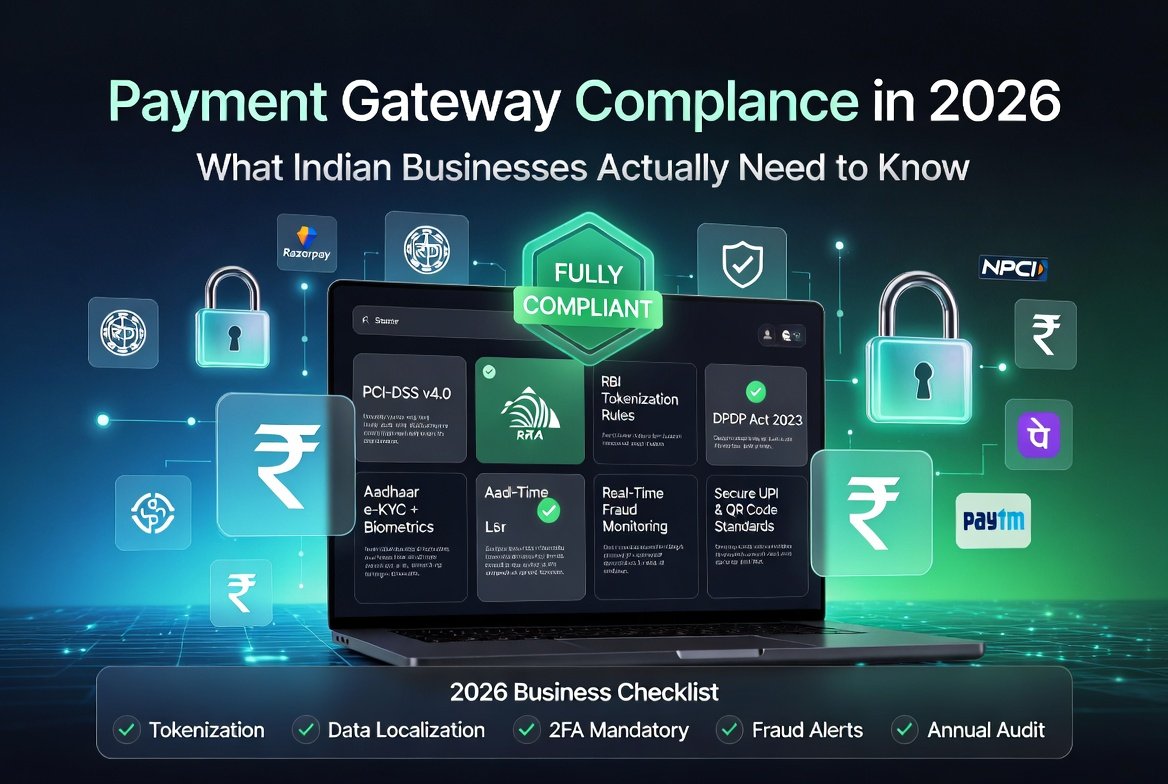
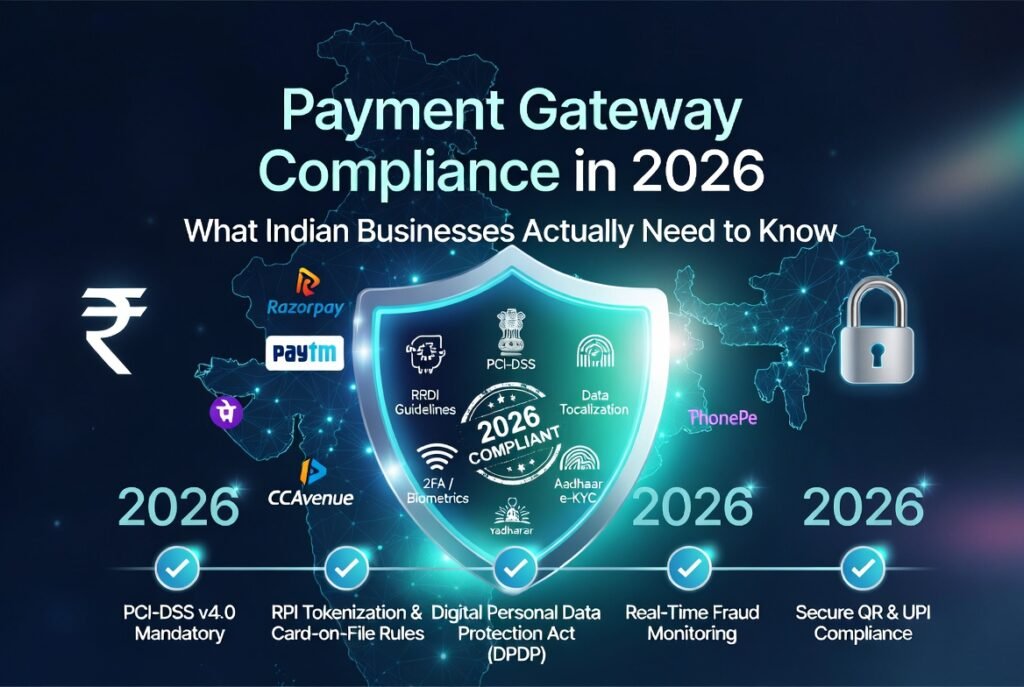
India’s digital payments ecosystem is growing at an unprecedented pace. With billions of transactions happening every month—driven largely by UPI, cards, and net banking—online payments have become the backbone of modern commerce. However, this rapid growth has also brought stricter regulations and heightened scrutiny.
As of 2026, payment gateway compliance is no longer a backend technical concern—it is a core business requirement. Whether you’re a startup, an e-commerce store, or an enterprise platform, failing to comply with the latest rules can result in rejected integrations, frozen funds, or even legal penalties.
This guide breaks down everything Indian businesses need to know about payment gateway compliance in 2026—from documentation and website requirements to technical security and regulatory obligations.
Why Compliance Matters More Than Ever
The regulatory landscape for digital payments in India has evolved significantly over the past few years. Updated RBI guidelines and global security standards have redefined how businesses must handle transactions and customer data.
Compliance today is not just about avoiding penalties—it directly impacts:
- Your ability to activate a payment gateway
- Customer trust and conversion rates
- Business continuity and scalability
Non-compliance can lead to serious consequences such as:
- Payment gateway integration rejection
- Suspension or deactivation of merchant accounts
- Freezing of settlement funds
- Financial penalties under Indian laws
Simply put, without compliance, your online payment system cannot function reliably.
The Core Compliance Checklist
Before integrating a payment gateway, every business must meet certain foundational requirements. These fall into four main categories:
1. Corporate Documentation
Payment aggregators verify your business identity before onboarding. You must have:
- PAN card (business or proprietor)
- GST registration certificate
- Certificate of incorporation (for companies)
- Bank account proof (cancelled cheque or statement)
- Address proof
The most critical rule:
Your business name must match exactly across all documents. Even small inconsistencies can delay or reject onboarding.
2. Website Disclosures
Your website acts as your first compliance checkpoint. Payment gateways will review it before approving your account.
You must clearly display:
- Legal business name
- Registered physical address
- Email and phone number
- Customer support details
In addition, the following policies are mandatory:
- Terms and Conditions
- Privacy Policy (clearly explaining data usage)
- Refund and Cancellation Policy (with defined timelines)
These should be easily accessible—preferably linked in the footer and visible during checkout.
3. Technical Security Requirements
Security standards have become stricter in 2026. Businesses must ensure:
- HTTPS enabled across the entire website
- TLS 1.2 or higher encryption
- Secure handling of payment data
- Protection against fraud and data breaches
Even if you use a payment gateway, your own website must meet minimum security standards.
4. Regulatory Compliance
Indian regulations now require strict adherence to:
- Data localization rules
- Tokenization for card storage
- Merchant KYC verification
- Grievance redressal mechanisms
Ignoring any of these can block your payment setup entirely.
Mandatory Website Requirements: What You Must Display
One of the most common reasons for payment gateway rejection is incomplete website information.
Business Identity
Your website must clearly mention:
- Legal entity name (not just brand name)
- Full physical address (no PO boxes)
- Valid contact details
This information should be visible on a dedicated “Contact Us” page.
Policy Transparency
Transparency builds trust—and is required by law.
Make sure your:
- Terms and Conditions are easy to find
- Privacy Policy explains what data you collect and why
- Policies are linked on every page (footer placement is ideal)
Refund and Cancellation Policy
Your refund policy must:
- Include specific timelines (e.g., 5–7 business days)
- Clearly explain eligibility conditions
- Avoid vague language
Unclear or misleading refund terms can result in rejection.
Product and Pricing Clarity
Every product or service listed must have:
- Clear description
- Accurate pricing
- Currency displayed in INR
Hidden charges or misleading details can flag compliance issues.
Grievance Redressal: A Non-Negotiable Requirement
Every online business must appoint a Grievance Officer or Nodal Officer.
This is mandatory under Indian regulations.
You must display:
- Officer’s full name
- Designation
- Email address
- Phone number
Complaint Handling Timeline
- Acknowledge complaints within 48 hours
- Resolve issues within 30 days
Failure to meet these requirements can lead to penalties or rejection during onboarding.
PCI DSS v4.0.1: The New Security Standard
If your business accepts card payments, PCI DSS compliance is essential.
The latest version, v4.0.1, introduced major updates in 2025.
Key Changes
1. Client-Side Security
Businesses must now monitor scripts running on payment pages.
This includes:
- Tracking all scripts
- Verifying their purpose
- Preventing unauthorized changes
This protects against digital skimming attacks.
2. Stronger Authentication
Multi-factor authentication is now required across more systems—not just admin access.
3. Real-Time Monitoring
Instead of periodic checks, businesses must implement continuous monitoring of security events.
4. Mandatory Encryption
All data transmission must use TLS 1.2 or higher.
Understanding Your Compliance Level
Not every business needs the same level of compliance.
SAQ (Self-Assessment Questionnaire)
Most businesses fall into this category.
- Hosted payment pages → Minimal scope
- API integrations → Higher responsibility
ROC (Report on Compliance)
Required for large enterprises processing high transaction volumes.
This involves a full audit by certified assessors.
RBI Regulations Every Business Must Follow
The RBI has introduced strict rules that directly affect merchants.
1. Merchant Due Diligence (MDD)
Payment aggregators must verify:
- Business legitimacy
- Ownership details
- Financial records
Even minor inconsistencies can cause delays.
2. Data Localization
All payment data must be stored in India.
If processed internationally:
- Data must be deleted from foreign servers within 24 hours
This applies to:
- Transaction data
- Card details
- Authentication records
3. Tokenization Rules
Businesses cannot store raw card data.
Instead:
- Use tokenization systems
- Replace card numbers with secure tokens
This ensures sensitive data is never exposed.
4. Recurring Payments Compliance
For subscriptions:
- Authentication is required during setup
- Additional verification for high-value transactions
- Pre-debit notifications must be sent
Failure to comply results in failed transactions and customer disputes.
Enterprise-Level Compliance Requirements
Larger businesses face additional obligations.
System Audits
You may need:
- Independent security audits
- System Audit Reports (SAR)
These evaluate your infrastructure and data handling practices.
Vendor Verification
Ensure your payment provider:
- Is authorized by regulators
- Meets security standards
- Provides reliable uptime
Choosing the wrong partner can put your business at risk.
Service-Level Agreements (SLAs)
Your payment system must maintain high uptime.
Frequent downtime can:
- Impact revenue
- Affect compliance standing
- Reduce customer trust
Marketplace Compliance
If you operate a marketplace:
- Verify sub-merchants
- Monitor transactions
- Follow anti-money laundering rules
This adds an extra layer of responsibility.
The Cost of Non-Compliance
Ignoring compliance can be expensive.
Potential consequences include:
- Fines up to ₹1 crore
- Monthly penalties for security violations
- Loss of customer trust
- Data breach costs
- Operational disruption
Beyond financial loss, the reputational damage can be long-lasting.
How Compliance Impacts Business Growth
Compliance is often seen as a burden—but it can be a growth driver.
Benefits of Being Compliant
- Faster payment gateway approvals
- Higher customer trust
- Better transaction success rates
- Reduced fraud risk
- Improved conversion rates
Customers are more likely to complete transactions on secure, transparent platforms.
Best Practices for Staying Compliant
To ensure smooth operations:
1. Keep Documentation Updated
Regularly review and update business documents.
2. Audit Your Website
Ensure all required policies and details are visible.
3. Strengthen Security
Use secure hosting, encryption, and monitoring tools.
4. Train Your Team
Make sure your team understands compliance requirements.
5. Choose the Right Payment Partner
Work with providers that simplify compliance and reduce risk.
Final Thoughts
Payment gateway compliance in 2026 is not optional—it is the foundation of running an online business in India.
With evolving regulations and stricter enforcement, businesses must stay proactive. From website policies and KYC documentation to data security and regulatory adherence, every layer matters.
The key is to treat compliance as an ongoing process rather than a one-time task. Businesses that invest in compliance today not only avoid penalties but also build trust, improve performance, and position themselves for long-term growth.
In a competitive digital economy, secure and compliant payment systems are no longer just a requirement—they are a strategic advantage.