
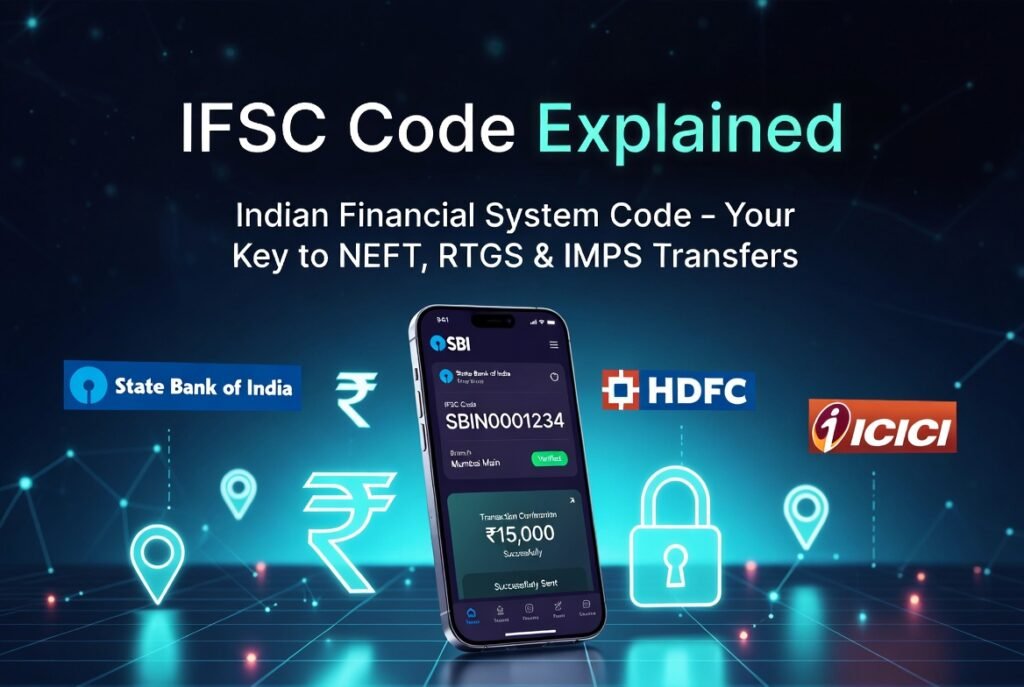
In the modern era of digital banking, transferring money has become as simple as a few taps on a smartphone. However, the backbone of these seamless transactions is a set of unique identifiers that ensure your money reaches the right person at the right branch. The most critical of these identifiers is the Indian Financial System Code (IFSC). Whether you are a business owner paying vendors or an individual sending money to family, understanding how to verify bank branch details using an IFSC code is a fundamental skill.
1. Introduction
An IFSC Code is a unique 11-character alphanumeric string assigned to every bank branch in India by the Reserve Bank of India (RBI). Its primary purpose is to identify a specific branch participating in electronic fund transfer systems.
This code is indispensable for various banking transactions, including:
- NEFT (National Electronic Funds Transfer): A nationwide system for one-to-one funds transfer.
- RTGS (Real-Time Gross Settlement): Used for high-value, instantaneous transactions.
- IMPS (Immediate Payment Service): Enables 24/7 instant money transfers.
Verifying bank branch details before initiating a transaction is vital. Using the wrong IFSC can lead to transaction delays, failures, or, in some cases, funds being misdirected to an unintended recipient. Ensuring the accuracy of these details through reliable tools is the first step toward secure digital banking.
2. What is an IFSC Code?
The structure of an IFSC code is standardized and follows a specific 11-character format to ensure zero ambiguity.
- First 4 Characters (Alphabetic): These represent the Bank Code. For instance, ‘SBIN’ stands for State Bank of India, ‘ICIC’ for ICICI Bank, and ‘HDFC’ for HDFC Bank.
- 5th Character: This is always a ‘0’ (zero). It is currently a placeholder reserved for future use by the RBI.
- Last 6 Characters (Alphanumeric): These characters represent the Branch Code. They uniquely identify the specific branch of that bank.
Example of a valid IFSC code: In the code BARB0TREASU:
- BARB represents Bank of Baroda.
- 0 is the reserved character.
- TREASU identifies the Treasury Branch in Mumbai.
Similarly, SBIN0001067 identifies the State Bank of India branch at the University of Delhi.
3. Why You Might Need to Check Bank Branch Details
While many people only think of IFSC codes during a transfer, there are several scenarios where verifying branch details is necessary:
- Online Money Transfers: To add a beneficiary for NEFT, RTGS, or IMPS, you must provide their branch’s IFSC code.
- Avoiding Transaction Failures: If a bank branch has merged or its location has changed, the old IFSC might become invalid. Checking the current details prevents rejected payments.
- Verifying Beneficiary Information: Before sending a large sum, businesses often verify the branch address and bank name to ensure the details provided by a vendor are legitimate.
- Business and Compliance Needs: For processing bulk salary disbursements or vendor invoices, businesses require accurate branch mapping to maintain smooth cash flow.
4. Step-by-Step Guide to Check Bank Branch Details Using IFSC Code
There are several ways to find or verify bank details. Below are the most effective methods.
Method 1: Using a Dedicated IFSC Lookup Tool (Recommended)
For the fastest and most user-friendly experience, using a dedicated lookup tool like ifsc.arjunwatchandmobile.com is highly recommended. These platforms aggregate data from official sources to provide instant results without navigating complex government portals.
Steps to use the tool:
- Visit the website: Open your browser and go to ifsc.arjunwatchandmobile.com.
- Enter the IFSC Code: Type the 11-character code (e.g., ICIC0000004) into the search bar.
- Click Search: Hit the submit or search button.
- View Details: The website will instantly display the Bank Name, Branch Name, Full Address, and often contact numbers associated with that specific IFSC.
Benefits:
- Speed: Much faster than manual searching through PDF lists or bank apps.
- Accuracy: Uses verified databases to ensure the information is current.
- Ease of Use: Designed for beginners with a simple, clutter-free interface.
Method 2: Using Official Bank Website
Most banks provide a “Branch Locator” or “Find IFSC” tool on their official site.
- Go to the bank’s official website (e.g., sbi.co.in or hdfcbank.com).
- Look for the Branch Locator or ATM/Branch Finder section.
- Enter the branch name or area, and the site will display the IFSC.
Method 3: Using the RBI Website
The Reserve Bank of India maintains a comprehensive directory of all bank branches.
- Visit the RBI official website and navigate to the IFSC/MICR search section.
- Select the Bank Name from the dropdown menu.
- Choose the State, District, and then the specific Branch.
- The system will generate the official IFSC and branch address.
Method 4: Using Mobile Banking Apps
If you are looking for your own branch details:
- Log in to your Mobile Banking App.
- Navigate to the Account Summary or Profile section.
- The IFSC code of your home branch is typically displayed alongside your account number.
Method 5: Using Google Search
You can simply type “IFSC [Code]” into Google. While convenient, be cautious. Google results can sometimes show third-party sites that may have outdated information. Always cross-verify the results with a trusted tool like ifsc.arjunwatchandmobile.com.
5. Tools and Platforms Comparison
| Feature | Dedicated Tool (e.g., ifsc.arjunwatchandmobile.com) | Bank Website | RBI Portal | Google Search |
|---|---|---|---|---|
| Speed | Instant | Moderate | Slow | Instant |
| User Friendliness | High | Moderate | Low | High |
| Accuracy | High | Very High | Highest | Moderate |
| Mobile Access | Optimized | Varies | Poor | Optimized |
Why a dedicated tool is better: While the RBI portal is the ultimate source of truth, it can be cumbersome to use. A dedicated tool like ifsc.arjunwatchandmobile.com provides the same verified data in a much more accessible and faster format.
6. Example Walkthrough
Let’s say you have an IFSC code: ICIC0000004. You want to find out where this branch is located before sending money.
- Open ifsc.arjunwatchandmobile.com.
- Input ICIC0000004 in the search field.
- The results will show:
- Bank: ICICI Bank.
- Branch: Nariman Point, Mumbai.
- Address: 1st Floor, Nariman Bhavan, Nariman Point, Mumbai – 400021.
- Contact: 022-22819331.
Now you are confident that you are sending money to the correct branch in Mumbai!
7. Common Errors and How to Avoid Them
- Mixing ‘0’ (Zero) and ‘O’ (Letter): The 5th character is always a zero. People often mistakenly type the letter ‘O’.
- Incorrect Character Entry: Many IFSCs differ by just one character. Double-check every digit.
- Using Outdated Information: Bank mergers (like the merger of various associate banks into SBI) can change IFSC codes. Always use a live tool to check for the latest code.
- Misidentifying Branches: Two branches might have similar names (e.g., Delhi University vs. South Campus). The IFSC is the only way to distinguish them.
8. Safety and Verification Tips
- Cross-Verify: Always match the IFSC from an online tool with the one printed on your chequebook or passbook.
- Avoid Suspicious Sites: Use only trusted, well-known tools like ifsc.arjunwatchandmobile.com to avoid phishing or malware.
- Confirm with the Beneficiary: If possible, ask the recipient to send a photo of their passbook’s front page to ensure you have the right details.
- Numerical Patterns: Recognize that most SBI codes start with ‘SBIN000’ and HDFC codes with ‘HDFC000’.
9. FAQs
Q: Can IFSC codes change? A: Yes. When banks merge or branches relocate, the RBI may issue new IFSC codes for those branches.
Q: Is IFSC required for UPI? A: Usually, you only need a mobile number or VPA for UPI. However, for “Account + IFSC” transfers within UPI apps, the code is mandatory.
Q: What happens if the IFSC is incorrect? A: If the account number exists in another branch, money might go to the wrong person. However, if the combination is invalid, the transaction will fail, and the bank will generally return the funds to your account within a few hours.
Q: Can one IFSC belong to multiple branches? A: No. Each IFSC is unique to a specific bank branch.
10. Conclusion
Verifying bank branch details is a simple yet crucial step in ensuring the safety of your hard-earned money. By understanding the structure of the IFSC code and knowing where to look—be it your passbook, the official RBI site, or dedicated tools—you can avoid the stress of failed transactions.
For a hassle-free and lightning-fast lookup, always keep ifsc.arjunwatchandmobile.com bookmarked. It simplifies the complex world of banking codes into a user-friendly experience, making it the perfect companion for your digital banking needs. Stay informed, stay secure, and happy banking!